
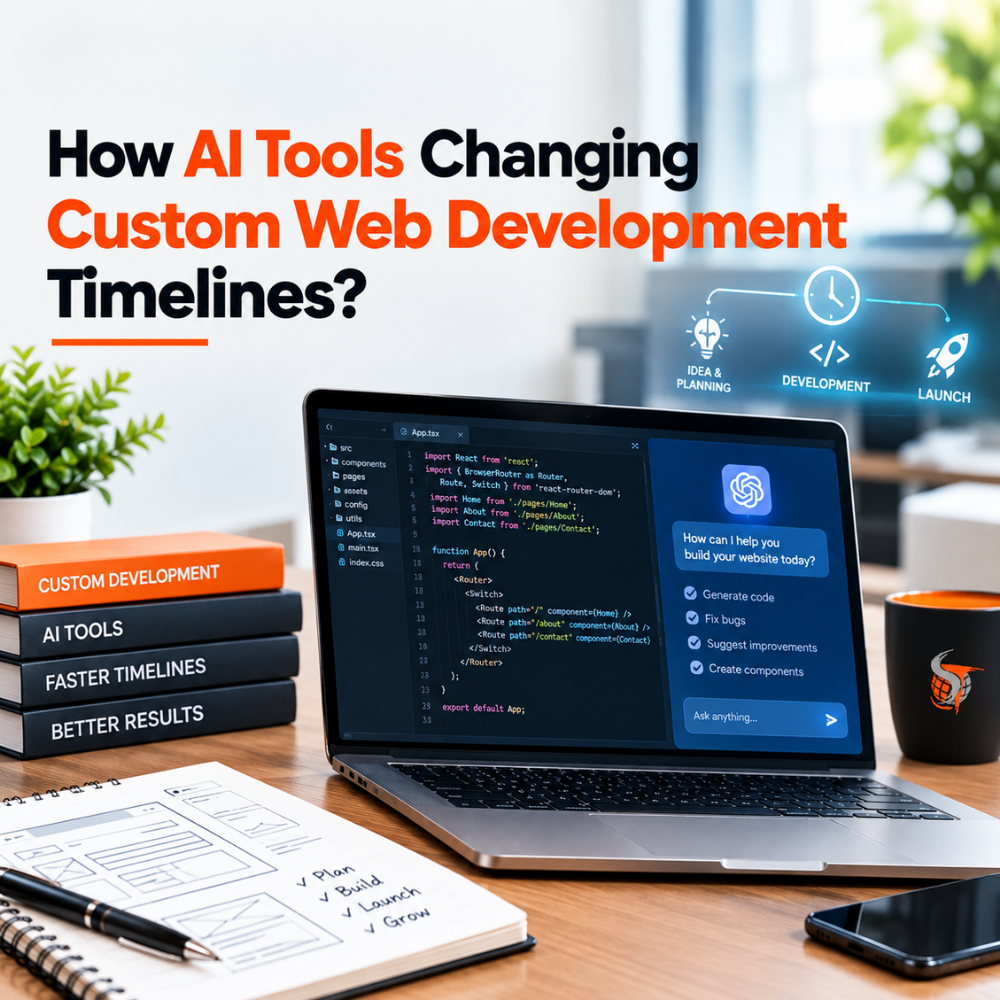
AI coding tools like Claude and Cursor are cutting custom web development timelines significantly by automating routine coding, documentation, and refactoring work, which means projects that once took around two months can often be delivered in closer to half that time, closing the speed gap that used to be the main reason businesses chose a website builder over custom code.
Key Takeaways
- AI coding tools like Claude and Cursor speed up custom web development by automating repetitive coding, documentation, and refactoring tasks.
- McKinsey research found developers complete certain coding tasks up to twice as fast with generative AI tools, though gains shrink sharply on complex, unfamiliar work.
- Custom development timelines that used to run 8+ weeks can often compress to roughly half that on well-scoped projects, though complexity still drives the real number.
- Speed was traditionally a website builder’s biggest advantage, AI tooling is closing that gap without giving up custom code’s flexibility.
- AI tools speed up how fast code gets written, but human developers are still essential for architecture, quality review, and business logic.
“We need it fast” used to mean choosing a website builder over custom code. That trade-off is shifting. AI coding assistants like Claude and Cursor now help write, document, and refactor large sections of code, compressing timelines that used to take months.
This raises a real question for growing businesses: if custom development can now move at builder-like speed, does the old trade-off between speed and flexibility still hold? Here’s what Store Transform is seeing as AI tools reshape how custom sites actually get built.
This isn’t a claim that every project now finishes twice as fast, no matter what. It’s a shift in where the time actually goes, less of it spent on repetitive coding work, more of it available for the planning, testing, and customization that make a site worth building from scratch in the first place.
What Are AI Coding Tools Like Claude and Cursor?
Claude is an AI assistant capable of writing, explaining, and debugging code from natural-language instructions, while Cursor is an AI-powered code editor built around similar models to help developers write and edit code faster inside their existing workflow. Both fall under generative AI-based development tools, which are software programs that generate or modify code based on prompts rather than requiring a developer to write every line manually.
These tools sit inside a developer’s existing process rather than replacing it. A developer still scopes the project, reviews every suggestion, and decides what actually ships, the tool just removes a lot of the manual typing and lookup work along the way. Other tools like GitHub Copilot work similarly, and most development teams now use more than one of these assistants side by side, whether they’re building on WordPress, Shopify, or Magento.
Why Development Speed Used to Favor Website Builders
Website builders have historically had one clear speed advantage: templates skip the planning, coding, and testing phases a custom project requires. A basic builder site could go live in days, while a fully custom build routinely took six to ten weeks or longer, depending on scope.
That gap made builders the default answer whenever a business needed something live quickly, even when a template didn’t really fit the business’s actual needs. Speed, not suitability, often won the decision.
Businesses that picked a builder purely for speed frequently hit its ceiling later, needing a custom checkout flow, a specific integration, or a page-speed fix the platform simply couldn’t deliver. At that point, the site often had to be rebuilt anyway, just later and under more pressure. AI-assisted custom development is starting to remove that trap by making the “build it right the first time” option competitive on timeline, not just on quality.
How AI Tools Are Compressing Custom Development Timelines
According to McKinsey’s 2023 developer productivity research, software developers using generative AI tooMcKinsey’s 2023 developer productivity research ls completed certain coding tasks up to twice as fast as those working without them. Documentation tasks were completed in about half the time, new code generation in nearly half the time, and code refactoring in nearly two-thirds the time compared with unassisted work.
In practical terms, a custom build that once took around two months can often move to roughly half that timeline when AI-assisted coding is applied to well-scoped, repeatable parts of the project. That’s an illustrative pattern, not a guarantee, the real number still depends on how much of the project is genuinely repeatable.
The same McKinsey research found an important limit worth being upfront about: time savings dropped to under 10% on tasks developers rated as high-complexity, such as working with an unfamiliar framework. Speed gains are real, but they’re concentrated in specific, well-understood types of work.
Where AI Tools Help Most in a Custom Build
- Generating boilerplate code and standard component structures
- Writing and updating code documentation
- Refactoring existing code for performance or maintainability
- Speeding up debugging by explaining errors and suggesting fixes
- Accelerating routine integrations with well-documented APIs
Where Human Developers Still Matter Most
- Deciding site architecture and how systems fit together
- Reviewing AI-generated code for security, quality, and business logic
- Handling unfamiliar frameworks or highly complex, custom logic
- Making judgment calls that require understanding of your specific business
This division of labor is exactly why our custom web development process still runs through structured planning, testing, and review stages, even with AI tools accelerating the coding itself. Skipping that oversight to chase a faster timeline is usually where quality problems start, which is also why businesses often choose to hire dedicated developers rather than relying on AI output alone.
Custom Web Development vs Website Builders: How the Speed Gap Has Changed
- Typical Time to Launch
- Website Builder: Days.
- AI-Assisted Custom Development: Weeks, often roughly half of pre-AI timelines on suitable projects.
- Design Flexibility
- Website Builder: Limited to platform templates.
- AI-Assisted Custom Development: Fully custom to your brand and use case.
- Scalability
- Website Builder: Constrained by platform limits.
- AI-Assisted Custom Development: Built to scale with your business.
- Ownership
- Website Builder: You rent the platform.
- AI-Assisted Custom Development: You own the code and data outright.
- Best Fit
- Website Builder: Simple sites, tight timelines, and low complexity.
- AI-Assisted Custom Development: Businesses that need speed and full control.
Real-World Example: Faster Builds Without Losing Customization
Store Transform’s Shopify development work for Better Man Labs involved building custom, user-friendly storefront features rather than relying on default templates, resulting in enhanced customer engagement and increased sales. Projects like this are exactly where AI-assisted coding adds the most value today, speeding up the repeatable parts of the build so more time goes toward the custom features that actually differentiate the store, whether the platform is Shopify, Magento, or WordPress.
The pattern holds across project types: the more a build relies on well-understood, repeatable code, standard components, common integrations, routine documentation, the more an AI-assisted workflow can compress the schedule without touching the parts that genuinely need custom thinking.
What This Means for Businesses Operating Globally
For companies scaling across multiple countries, faster custom development matters even more, since region-specific pricing, tax logic, and localized content used to be some of the most time-consuming parts of a build. Store Transform works with ecommerce and service brands across 32+ countries, and AI-assisted workflows are increasingly what makes multi-region custom projects realistic on tighter timelines.
Multi-region builds often involve the kind of repeatable structure AI tools handle well, similar page templates repeated across markets, standard currency and shipping logic, and consistent metadata patterns. That repetition is where the time savings compound the most.
If speed is the priority but you’re moving from an existing builder-based site, protecting your SEO rankings during that move still matters. Our guide on how to redesign your ecommerce website without losing traffic covers how to manage that transition properly.
Conclusion
AI coding tools haven’t replaced the case for custom development, they’ve removed its biggest drawback. With Claude, Cursor, and similar tools speeding up the repeatable parts of a build, businesses no longer have to choose between getting a site live quickly and getting one built the right way. The trade-off that used to push companies toward website builders is smaller than it used to be, and it keeps shrinking as these tools mature. If you want to see what a faster, AI-assisted custom build could look like for your project, Store Transform’s custom web design and digital marketing teams can walk you through it.
Frequently Asked Questions
Do AI tools like Claude and Cursor actually make web development faster?
Yes, for many tasks. McKinsey research found developers completed coding tasks up to twice as fast using generative AI tools, particularly for documentation, new code generation, and refactoring. Gains are much smaller on complex or unfamiliar work.
Can AI tools fully replace custom developers?
No. AI tools speed up specific coding tasks, but developers are still needed for architecture decisions, code review, security, and business logic that requires understanding your specific project. Most teams use AI tools to augment developers, not replace them.
Does faster development with AI tools mean lower quality?
Not necessarily. McKinsey’s research found code quality was comparable or marginally better when developers actively reviewed and iterated with AI-generated code, rather than accepting outputs without review. Quality depends on the review process, not just the tool used.
How much faster is custom web development with AI tools compared to before?
Speed gains vary by project, but McKinsey found time savings of up to 50% on tasks like documentation and code generation, dropping to under 10% on high-complexity work. A project’s actual timeline still depends heavily on its specific scope and complexity.
Is a website builder still faster than AI-assisted custom development?
A basic website builder site can still go live faster for very simple projects with no custom functionality. For projects that need real customization, AI-assisted custom development has narrowed that speed gap considerably compared to a few years ago.
What tools does Store Transform use for AI-assisted development?
Store Transform’s process incorporates AI-powered tools into web development and delivery, consistent with the AI-driven approach described on our homepage. Specific tools are discussed directly with clients during project scoping, since the right combination depends on the platform and project.