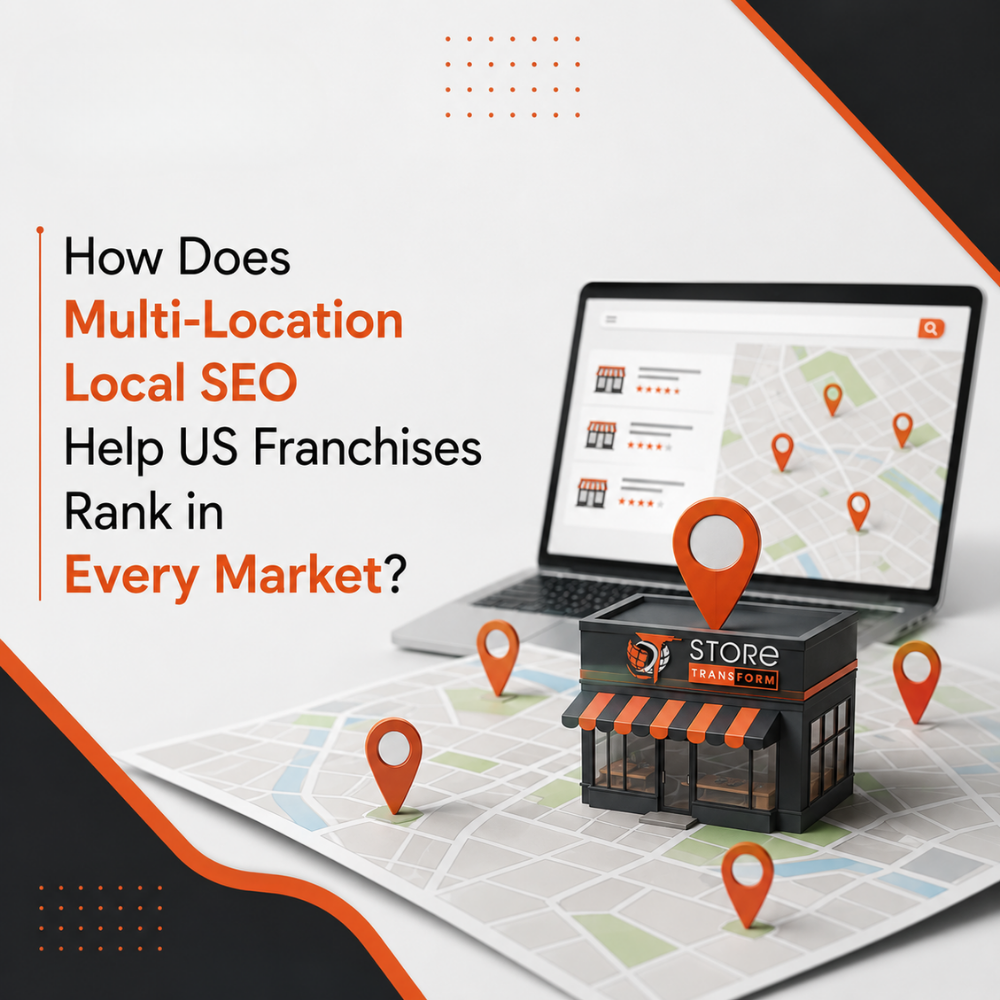
Multi-location local SEO helps US franchises rank in every market by creating individual, optimized Google Business Profiles for each store, using location-specific landing pages, maintaining consistent NAP (Name, Address, Phone) data across directories, and managing reviews at the store level rather than the brand level. This prevents locations from competing against each other in search results.
Franchise owners and multi-store brands face a problem single-location businesses never encounter: their own locations competing against each other on Google. One poorly optimized store profile can drag down visibility for the entire chain in that market. This guide explains exactly how to structure your SEO so every location ranks independently, attracts local customers, and reinforces, rather than undermines, your brand’s overall search presence.
Key Takeaways
- Each location needs its own Google Business Profile, not a shared brand-level listing
- Location pages must have unique content, not duplicated brand copy with a swapped city name
- NAP consistency across directories directly affects local ranking
- Review management should happen at the store level to catch location-specific issues
- Centralized tracking prevents locations from cannibalizing each other’s rankings
What Is Multi-Location Local SEO?
Multi-location local SEO is the practice of optimizing search visibility for a brand with multiple physical locations, where each location needs to rank independently in its own local market. Unlike single-location SEO, it requires managing dozens or hundreds of separate local signals, Google Business Profiles, citations, reviews, and location pages, while keeping brand consistency intact across all of them. This is a core part of the digital marketing strategy Store Transform builds for multi-store clients.
Why Franchises Struggle With Local SEO More Than Single Stores
A single-location business optimizes one Google Business Profile and one set of local citations. A franchise with 40 locations effectively runs 40 separate local SEO campaigns simultaneously, and most brands underestimate this. Common failure points include:
- Duplicate or near-duplicate content across location pages, which Google may treat as low-value
- Inconsistent business names across directories (e.g., “Joe’s Pizza Dallas” vs. “Joe’s Pizza – Dallas Location”)
- Franchisees managing their own listings inconsistently, with no centralized oversight
- Corporate SEO efforts focused only on the brand homepage, leaving location pages neglected
Franchises that treat local SEO as a single, brand-wide effort typically underperform independent local competitors who focus entirely on one market.
Building a Location Page Structure That Ranks
What Each Location Page Needs
- Unique, location-specific content mention local landmarks, service areas, and store-specific offerings, not just a city name swap
- Embedded Google Map for that specific address
- Local phone number (not a shared national line) where possible
- Store-specific hours, staff, and services if they differ from other locations
- Localized schema markup (LocalBusiness schema per page)
Building this structure at scale is a technical undertaking best handled through proper web development rather than manual page duplication, particularly for franchises running on WordPress or larger custom platforms.
Centralized vs. Decentralized Management
- Fully centralized (corporate-managed)
- Pros: Consistent branding, easier auditing
- Cons: Slower to reflect local nuances
- Fully decentralized (franchisee-managed)
- Pros: Local knowledge, faster updates
- Cons: Inconsistent quality, brand risk
- Hybrid (corporate template + local input)
- Pros: Balances consistency and local relevance
- Cons: Requires clear governance and tools
Most successful franchise SEO programs use a hybrid model: corporate sets the technical foundation and brand standards, while local managers contribute market-specific details. Store Transform typically implements this hybrid structure when building multi-location websites for franchise clients, since it balances scalability with local relevance. Brands without in-house technical staff can also hire a developer directly to manage the location page template.
Google Business Profile Management at Scale
Each location’s Google Business Profile functions as its own ranking entity. Google’s own guidance confirms that business information accuracy and completeness directly affect local ranking eligibility (see Google’s Business Profile help documentation on ranking factors at support.google.com/business.
Core GBP Tasks Per Location
- Verify and claim every location individually
- Use consistent categories across all listings unless a location genuinely differs
- Upload location-specific photos, not stock brand imagery
- Respond to reviews per location, addressing specific feedback rather than generic replies
- Post location-relevant updates (local promotions, events) rather than only brand-wide announcements
Franchises running paid campaigns alongside organic efforts often coordinate this with PPC management so local promotions on Google Business Profile align with active ad campaigns in the same market.
NAP Consistency: The Foundation Most Franchises Get Wrong
NAP (Name, Address, Phone) consistency means your business information matches exactly across every directory, citation, and page where it appears. Even small discrepancies, “St.” vs. “Street,” or a missing suite number — can confuse Google’s local algorithms and dilute ranking signals across an entire chain.
How to Audit NAP at Scale
- Export all location data into a single spreadsheet as the source of truth
- Cross-check against major directories (Google, Yelp, Bing Places, Apple Maps)
- Correct inconsistencies systematically, starting with highest-traffic locations
- Re-audit quarterly, since franchisee changes often introduce new errors
Mini case study: A US multi-store retail brand working with Store Transform had 22 locations with inconsistent NAP data across directories, causing several stores to rank below independent competitors in their own neighborhoods. After a full citation audit and standardized location page rebuild, the majority of underperforming stores moved into local map pack visibility within a few months, without any change in ad spend. Similar results are documented across Store Transform’s portfolio.
Conclusion
Multi-location local SEO succeeds when every location is treated as its own local business rather than a copy of the brand homepage. Unique location pages, consistent NAP data, and store-level review management prevent internal competition and strengthen visibility across every market you serve. For franchises ready to fix inconsistent local rankings, Store Transform’s SEO services build and audit multi-location strategies designed to scale. Explore more strategy breakdowns on the Store Transform blog, or get in touch to discuss your franchise’s local visibility.
Frequently Asked Questions
What is the difference between local SEO and multi-location local SEO?
Local SEO optimizes one business for one geographic market. Multi-location local SEO manages this process across many locations simultaneously, requiring separate Google Business Profiles, unique location pages, and centralized oversight to prevent locations from competing against each other.
How many Google Business Profiles does a franchise need?
A franchise needs one verified Google Business Profile per physical location. Shared or duplicate profiles for multiple addresses violate Google’s guidelines and can result in suspension of some or all listings.
Do all franchise locations need separate landing pages on the website?
Yes. Each location should have its own page with unique content, local schema markup, and location-specific details. Duplicate content across location pages weakens SEO performance for the entire chain.
How does review management differ for multi-location businesses?
Reviews must be monitored and responded to at the individual store level, since issues are typically location-specific. Centralized, generic responses across all locations reduce trust signals and can miss recurring problems at underperforming stores.
What causes franchise locations to compete against each other in search results?
Duplicate content, identical meta titles, and near-identical location pages cause Google to struggle distinguishing between locations, sometimes ranking one page while suppressing others in the same city or region.
Should local SEO be managed by corporate or by individual franchisees?
A hybrid model works best: corporate sets technical standards, schema, and brand consistency, while franchisees or local managers handle store-specific content, reviews, and community engagement.