

In 2026, the best Google Ads bidding strategies for US eCommerce brands are Target ROAS for stores with 30+ monthly conversions, Maximize Conversion Value for newer accounts still building data, and Performance Max layered with first-party audience signals. The right choice depends on your conversion volume, order value, and margin targets.
Key Takeaways
- Target ROAS works best once a campaign has 30+ conversions in the past 30 days; below that, use Maximize Conversion Value first.
- Google changes how budget-limited tCPA and tROAS campaigns deliver starting August 17, 2026, review your targets now.
- Performance Max remains Google’s recommended structure for eCommerce, but performs best with accurate first-party conversion data.
- Manual CPC is now mainly useful for brand-defense and thin-data test campaigns, not core revenue-driving PPC.
- Switching strategies too often resets Smart Bidding’s learning phase and can cost weeks of wasted spend.
- Store Transform helps eCommerce brands across the USA, UK, and Canada choose and manage the right bidding strategy based on account maturity and margin structure.
If your Shopify or Magento store spends on Google Ads without a clear bidding strategy, you’re likely overpaying for clicks that don’t convert. Choosing between Target CPA, Target ROAS, and Performance Max isn’t a minor setting, it determines whether your budget turns into profitable orders or wasted impressions. This guide breaks down which strategy fits your store in 2026, including platform changes every advertiser needs to prepare for.
What Is a Google Ads Bidding Strategy?
A Google Ads bidding strategy is the method the platform uses to decide how much to bid in each ad auction, based on the goal you set, clicks, conversions, or conversion value. For eCommerce, it determines whether Google optimizes toward the number of sales or the total revenue those sales generate, which matters when products have very different price points.
Top Google Ads Bidding Strategies for eCommerce in 2026
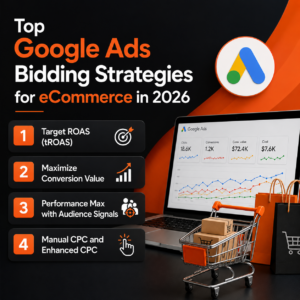
1. Target ROAS (tROAS)
Target ROAS tells Google’s algorithm to maximize conversion value at a specific return ratio, such as 400%. It’s the standard choice for established stores because it accounts for order value, not just order count — a $200 sale and a $20 sale are treated differently.
- Best for: stores with at least 30 conversions in the past 30 days
- Watch for: an aggressive target set before the algorithm has enough data, which throttles reach
2. Maximize Conversion Value
This strategy spends your full daily budget to generate the highest total conversion value possible, with no fixed ROAS target. It’s the recommended starting point for newer accounts, since it feeds Smart Bidding the data it needs before you apply a tROAS constraint.
- Best for: new campaigns or brands relaunching a product line
- Watch for: no built-in cost ceiling, so spend can concentrate on a few high-value orders
3. Performance Max with Audience Signals
Performance Max remains Google’s flagship campaign type for retail, bidding across Search, Shopping, Display, YouTube, and Gmail from one campaign. The advantage is pairing that automation with first-party audience signals — email lists, past purchasers, high-value segments — so the algorithm starts from a stronger baseline.
- Best for: brands with a product feed and steady site traffic
- Watch for: limited channel-level reporting, which makes underperformance harder to diagnose
4. Manual CPC and Enhanced CPC
Manual bidding has a narrow role in 2026: brand-defense campaigns where you want tight cost control, or test campaigns with zero conversion history where Smart Bidding has nothing to learn from yet.
- Best for: brand keyword protection, diagnostic test campaigns
- Watch for: it doesn’t scale efficiently once your account has real conversion volume
The August 2026 tCPA and tROAS Enforcement Change
Every US eCommerce advertiser using Target CPA or Target ROAS should know about a system-level change Google is rolling out. Starting August 17, 2026, budget-limited campaigns on a target-based bid strategy will be steered more consistently toward the exact target you typed in. <cite index=”10-1″>Google confirms this applies to Search, Shopping, Performance Max, and Demand Gen campaigns using a target-based bid strategy.</cite> In practice, <cite index=”4-1″>campaigns marked “limited by budget” that have historically beaten their stated tCPA or tROAS will be pushed closer to the target actually set.</cite> If your tROAS is 400% but converting at 500%, expect drift toward 400% unless you adjust it first.
Audit every budget-limited campaign before August 17, 2026, compare stated targets against actual performance, and update targets to reflect real numbers.
Bidding Strategy Comparison
- Target ROAS — best for established stores with varied order values; needs 30+ conversions/30 days; risk: too-high target throttles reach.
- Maximize Conversion Value — best for new/relaunching accounts; needs little to no data; risk: no cost ceiling.
- Performance Max — best for multi-channel retail brands; needs solid product feed + steady traffic; risk: limited channel-level visibility.
- Maximize Conversions — best for accounts still building history; needs minimal data; risk: no revenue weighting.
- Target CPA — best for lead gen, not product sales; needs consistent conversion value; risk: ignores revenue differences.
- Manual/Enhanced CPC — best for brand defense and test campaigns; needs no historical data; risk: doesn’t scale with volume.
How to Choose the Right Strategy for Your Store

Step 1: Audit Your Conversion Tracking
Smart Bidding is only as accurate as the data feeding it. Confirm purchase events and order values fire correctly before trusting any automated strategy.
Step 2: Match Strategy to Data Volume
- Under 15 conversions/month: Maximize Conversion Value or Maximize Clicks
- 15–30 conversions/month: Maximize Conversion Value, preparing to transition
- 30+ conversions/month: Target ROAS with a realistic starting target
Step 3: Avoid Strategy-Hopping
Changing bid strategy type resets the learning phase and can cost one to three weeks of volatile performance. We see this most with growing Shopify brands that switch strategies every two weeks chasing a lower CPA. A mid-sized apparel client Store Transform worked with stabilized results by staying on Maximize Conversion Value for six weeks before introducing a tROAS target — conversion value rose with no creative or budget change, purely from letting the data mature.
As a digital marketing agency for US eCommerce brands, Store Transform builds bidding strategy around actual store data rather than platform defaults. Our PPC management team pairs Smart Bidding with structured SEO work so paid and organic reinforce the same conversion signals Google needs. See our related guide on high-ROI PPC campaigns.
Conclusion
Choosing the right Google Ads bidding strategy in 2026 comes down to matching the strategy to your conversion data, order value spread, and the August 17 tCPA/tROAS enforcement update. Start with Maximize Conversion Value while building data, move to Target ROAS at 30+ monthly conversions, and audit targets now rather than after the deadline. Store Transform helps US eCommerce brands build bidding strategies that hold up under these changes, get in touch to review your account.
Frequently Asked Questions
What is the best bid strategy for Google Shopping ads? For most Shopping campaigns, Target ROAS is best once you have 30 or more conversions in the past 30 days. Before that, Maximize Conversion Value is preferred, since it builds the conversion-value data Target ROAS needs to work accurately.
How long does Google Ads Smart Bidding take to learn? Smart Bidding typically needs seven to fourteen days to exit its learning phase. High-volume campaigns with 50+ weekly conversions stabilize faster; low-volume campaigns can take three weeks or longer.
Should I use manual or automated bidding for eCommerce? Automated bidding, specifically Target ROAS or Maximize Conversion Value, outperforms manual bidding for most accounts with reliable tracking. Manual CPC is now mainly reserved for brand-defense keywords and low-data test campaigns.
What’s the difference between tCPA and tROAS? Target CPA optimizes for a fixed cost per conversion regardless of order value, suiting lead generation. Target ROAS optimizes for total conversion value at a set return ratio, fitting eCommerce where order values vary.
How many conversions do I need for Target ROAS to work well? Google recommends at least 30 conversions in the past 30 days per campaign. Below that, the algorithm lacks enough data to bid accurately, and Maximize Conversion Value is the safer choice.
What changes on August 17, 2026 for Google Ads bidding? Budget-limited campaigns using Target CPA or Target ROAS will be steered more precisely toward the exact target set, rather than continuing to overperform it. Advertisers should audit and adjust targets before this date to avoid cost increases.