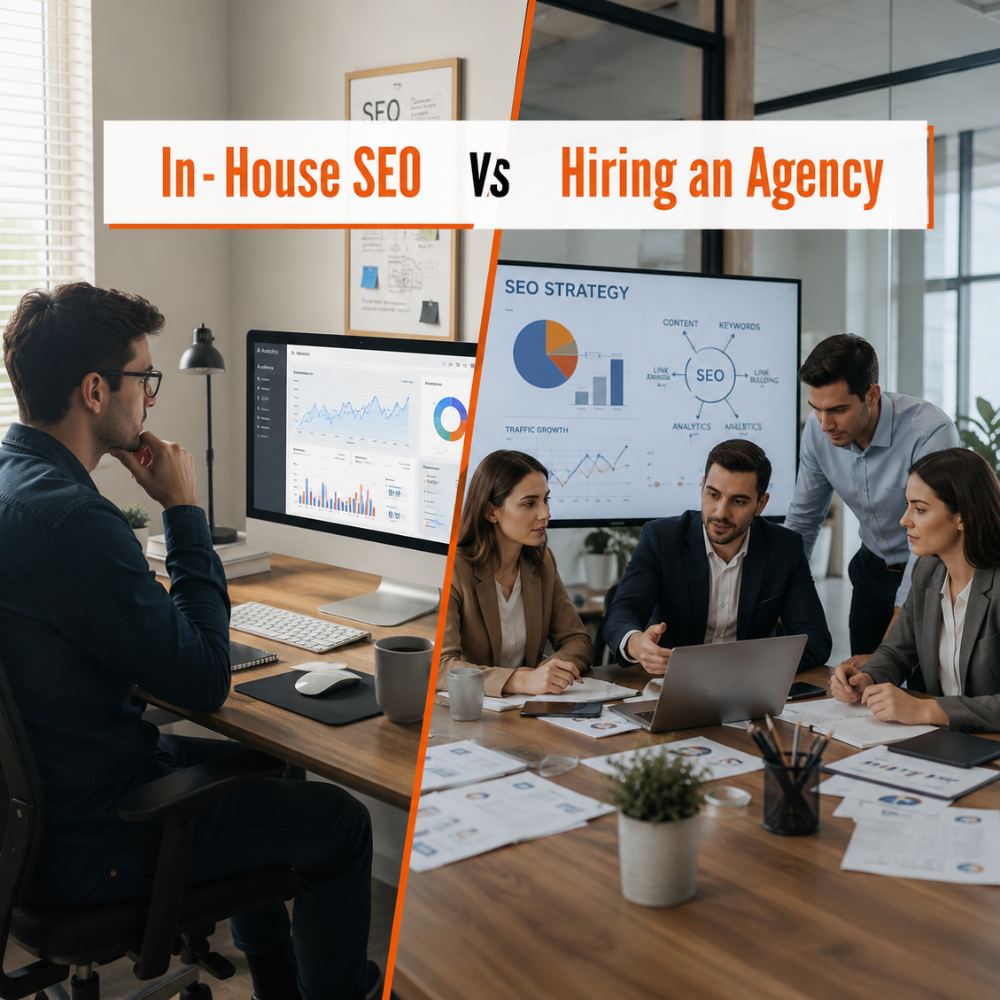
In-house SEO works best when you have a stable team, dedicated staff, and time to build expertise gradually. Hiring an SEO agency works better when you need immediate expertise, a full team of specialists, and measurable results without the overhead of a full-time hire. The right choice depends on your resources, growth stage, and how fast you need results.
Key Takeaways
- In-house SEO means committing to a full-time salary, benefits, tools, and training for at least one specialist.
- An SEO agency typically works on a single retainer arrangement that gives you access to a full team instead of one person, generally at less overall cost than a full-time hire.
- Agencies bring faster access to technical SEO, content, and AI Overview optimization expertise; in-house teams build deeper product knowledge over time.
- Smaller businesses usually see stronger ROI from an agency; larger companies with complex websites often do best with a hybrid model.
- Store Transform works with businesses across the USA, UK, and Canada using a hybrid approach that pairs agency expertise with client-side ownership.
Every growing business eventually asks the same question: build an SEO team in-house, or hire an agency? Getting this wrong can waste budget and delay rankings, especially now that Google’s AI Overview and tools like ChatGPT, Gemini, and Perplexity are reshaping how people search. This guide breaks down the real trade-offs, skill requirements, and decision factors for each option, so you can match your choice to your resources, team size, and growth goals.
What Is In-House SEO vs an SEO Agency?
In-house SEO means employing one or more specialists directly on your payroll to manage keyword research, content, technical fixes, and link building for your website. An SEO agency is an external team you hire on a contract or retainer basis to handle some or all of those same tasks, using expertise built across many clients and industries, this is often called outsourcing SEO services. Both approaches aim for the same outcome: higher rankings, more organic traffic, and stronger visibility in Google Search and AI-generated answers. What differs is the investment structure, the speed of results, and how deep the expertise runs on day one.
In-House SEO vs an SEO Agency: Comparing the Real Investment
Building an in-house SEO team requires a bigger commitment than most business owners expect once every element is counted. A single specialist needs a full-time salary, benefits, software subscriptions for rank-tracking and backlink-analysis tools such as Ahrefs or Semrush, reporting access through Google Search Console and Google Analytics, ongoing training, and management time. Because one person cannot realistically cover strategy, content, technical SEO, and link building at once, the true investment adds up quickly for capability that may still leave gaps.
Hiring an SEO agency turns that investment into a single retainer arrangement instead of a payroll commitment. That retainer typically covers a team of specialists rather than one generalist, along with the tools, reporting, and project management already built into the agency’s operations, and generally works out to less than the cost of a single full-time hire.
In-House SEO Team
- Requires a full-time salary, employee benefits, and ongoing training.
- SEO tools and software must be purchased and managed separately.
- Typically relies on one SEO specialist or a small internal team.
- Takes time to onboard and develop expertise before delivering results.
- Scaling requires recruiting and hiring additional employees.
- Best suited for large businesses with complex, ongoing SEO requirements.
SEO Agency
- Works on a single monthly retainer that covers a team of specialists.
- Provides immediate access to experts in technical SEO, content, link building, and reporting.
- Professional SEO tools are usually included in the service.
- Can easily scale services by adjusting the existing contract.
- Reduces hiring, training, and employee management costs.
- Ideal for small to mid-sized businesses seeking flexible, cost-effective SEO support.
Pros and Cons of In-House SEO
Advantages
- Full control over priorities and direct access to institutional knowledge about your products and brand.
- Your specialist works exclusively on your site, with no divided attention across other clients.
- Builds product-specific expertise over time that is hard for an outside team to match.
Disadvantages
- One person is rarely strong across every SEO discipline — technical audits, content, digital PR, and structured data each need different skills.
- Turnover risk: when a lone in-house SEO leaves, momentum and institutional knowledge often leave with them.
- Replacing a specialist can take a long time, during which SEO progress stalls.
Pros and Cons of Hiring an SEO Agency
Advantages
- Immediate access to a broader bench of expertise, without a hiring cycle.
- Specialists in technical SEO, content, local SEO, and AEO/GEO tactics for AI Overview and LLM visibility work together rather than one generalist juggling every discipline.
- Exposure to a wider range of industries and algorithm changes, since agencies manage this across many client sites at once.
Disadvantages
- Less day-to-day control, plus a learning curve while the agency gets familiar with your business and customers.
- Communication must be more deliberate, since the team is not inside your organization day to day.
Which Option Fits Your Business?
The right answer depends less on company size and more on three factors: how predictable you need your investment to be, the complexity of your website, and how quickly you need results. A single-location retailer with a straightforward website and a lean marketing team typically gets more value from an agency retainer than from a full-time hire, since the agency’s shared-team model works out more efficiently than a single salary. A large multi-region e-commerce brand with dozens of product categories, on the other hand, often benefits from a hybrid model: an in-house coordinator who manages priorities and brand context, supported by an agency handling technical execution, content production, and reporting at scale.
Example Scenario: Consider a mid-size online retailer generating steady traffic but flat organic revenue. After comparing what each option would require, the business found that a full-time in-house hire would cost more overall than a comprehensive agency retainer covering technical SEO, content, and reporting, while also taking longer to become fully productive. Moving to an agency model gave the business access to a full team right away, without the hiring risk. This pattern repeats across many small and mid-size businesses evaluating the same decision today.
Conclusion
Choosing between in-house SEO and an agency comes down to your resources, website complexity, and how quickly you need measurable results. Smaller businesses generally get more value from an agency’s ready-made team, while larger organizations often benefit from a hybrid approach. Store Transform provides search engine optimization and digital marketing services for businesses across the USA, UK, and Canada, including local SEO strategy. Get in touch to talk through which model fits your business.
Frequently Asked Questions
Is it cheaper to hire an SEO agency or build an in-house team?
For most small and mid-size businesses, an SEO agency is more cost-effective than a full in-house team, since agency retainers typically cost less than a full-time salary while still providing access to a complete team of specialists. In-house teams become more cost-effective only at a larger scale, once the workload justifies hiring multiple specialists directly.
How long does it take to see results from SEO?
SEO results build gradually rather than overnight, whether the work is done in-house or through an agency. Meaningful ranking and traffic improvements typically take sustained effort over an extended period, with the exact timeline depending on site age, competition, and how consistently the strategy is executed.
Can a small business handle SEO in-house?
Yes, a small business can handle basic SEO in-house, particularly on-page optimization and Google Business Profile management. However, technical SEO, content strategy at scale, and AI Overview optimization usually require specialized skills that are hard for one generalist to cover alone.
How many people do you need for an in-house SEO team?
A single in-house hire is rarely enough to cover every SEO discipline well. Full in-house coverage typically needs separate specialists for technical SEO, content, and link building, which is why many businesses choose an agency instead of building out a complete team internally.
What should I look for when hiring an SEO agency?
Look for transparent reporting, case studies relevant to your industry, clear communication about strategy and timelines, and evidence of experience with current search behavior, including Google AI Overview and AI-assisted search tools. Avoid agencies that guarantee specific rankings or refuse to share methodology.
Does Google’s AI Overview change how in-house teams and agencies approach SEO?
Yes. AI Overview and AI-assisted search tools reward clear, well-structured, factual content over keyword density, which requires updated skills in structured data, answer-focused writing, and entity optimization. Agencies that specialize in this shift, often called AEO or GEO, tend to adapt faster than a single in-house generalist.
Can I combine in-house SEO with an agency?
Yes, this hybrid model is common among growing businesses. An in-house team member manages brand context and internal coordination, while an agency handles technical execution, content production, and specialized tasks like link building or AI Overview optimization at scale.